“I hate this community.”
“Muslims are sellouts.”
“There is nothing good worth saving in this community.”
Work in the Muslim community long enough and you will encounter plenty of bad behavior: the trading of information, egos, racism, favoritism, and tribalism. But perhaps one of the hardest things to deal with is the feeling that your work is neither recognized nor appreciated.
I don’t deny any of these problems. I feel that frustration often, especially in activism, when trying to get people to care about issues I believe are important. You quickly learn that attention tends to flow toward issues the masses have already bought into, or toward easy, visible wins. Many people simply do not want to put in the work.
Let those frustrations accumulate over enough time, leave God out of the equation, and eventually they can become a spiritual crisis.
Dealing with people has its harms. It is something the Prophet ﷺ explicitly acknowledged.
It was narrated from Ibn ‘Umar that the Messenger of Allah ﷺ said:
“The believer who mixes with people and bears their annoyance with patience will have a greater reward than the believer who does not mix with people and does not put up with their annoyance.”
As for racism, tribalism, favoritism, and the other problems within our communities, they should be confronted and rectified. I won’t write apologetics for any of them.
But several years ago, after someone read some of my earlier posts about the Muslim community that had gone “viral,” he remarked, “I feel like you only write about the bad stuff.”
He was right.
The purpose of those posts was partly to get the bad stuff out of my head and into the world. I had tried addressing some of these problems privately, only to be met with empty platitudes and promises of change that never materialized. When I tried to galvanize people to confront the problem of nifaq head-on, at best my words became entertainment rather than the stark warning I intended them to be.
What remained were cowards, trolls, and, occasionally, brave leaders who effectively told me:
“Let us know when you make the news.”
In other words: We are going to ignore you now. But when you reach the front page of Wired, we will be in touch again.
My bitterness felt justified. But remain in that hollow state for too long and you begin to forget the promises of Allah SWT.
And remaining bitter requires a certain distance from the Qur’an, because the Qur’an keeps reminding us of truths we are prone to forget:
“And be patient! Certainly Allah does not discount the reward of the good-doers.”
Surah Hud, 11:115
“As for those who believe and do good, We certainly never deny the reward of those who are best in deeds.”
Surah al-Kahf, 18:30
“Surely those who recite the Book of Allah, establish prayer, and donate from what We have provided for them—secretly and openly—can hope for an exchange that will never fail.”
Surah Fatir, 35:29
That is the state I often find myself fighting, especially when trying to solicit help from others and receiving little or nothing in return. At best, there is verbal support. Somewhere in the middle, there is light trolling and gossip. At the worst, there is outright slander, mockery, and deliberate indifference.
“Can we at least get a hug?”
“No,” I respond. “I’m not a politician like you.”
I am not going to pretend that this betrayal, or the decision to ignore an issue that impacts the entire community, didn’t affect me. I can’t pretend that nothing is wrong.
It was in that state of mind that I entered the city of Meknes.
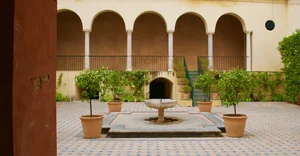
I walked into a Sufi zawiya with no idea what to expect. My intention with my camera was simply to capture some of God’s beauty.
The imam was waiting for us outside.

He welcomed us with a warm smile. Although we did not share the same language, I swear the emotion on his face made it seem as though our arrival had made his entire day. He was ecstatic that we had come.
They sang praises of the Prophet Muhammad ﷺ. They sang nasheeds. The imam sat us down and made sure we were comfortable, insisting that we take the best seats.
Our tour guide explained that he had grown up in this zawiya and learned there the importance of khidmah, service. Orphans had been taken off the streets, fed, housed, educated, and trained to become imams. When they completed their training, they were sent out to serve other communities.
Orphans raising other orphans.
The hosts sang beautiful nasheeds, reaching pitches and emotional heights I had never experienced in person. It reminded me of the qawwali my dad listened to when I was younger.

After praying Asr, it was not long before warm chicken tagine appeared, followed by fresh watermelon and other fruits whose names I did not even know but happily ate anyway.

Before we left, we made dua. Then the imam took us to a nearby maqam, the resting place of the shaykh who had taught him.
We made dua there as well. I took photographs.
The imam was grateful for the pictures and asked for my contact information. We still exchange messages to this day, mostly emojis, because even without a shared language, we understand that there is love between us.
As I left that maqam, I asked Allah SWT to forgive me.
I had been thinking so much about what people had failed to give me that I had forgotten what Allah had already given me.
Allah had blessed me by allowing me to serve Him.
I was not doing Allah a favor by serving His creation.
I had placed a magnifying glass over the bad experiences while forgetting the great people Allah had surrounded me with.
And perhaps the only reward you receive in this world for serving Allah is that He gives you another opportunity to serve Him.