Leaving a Legacy
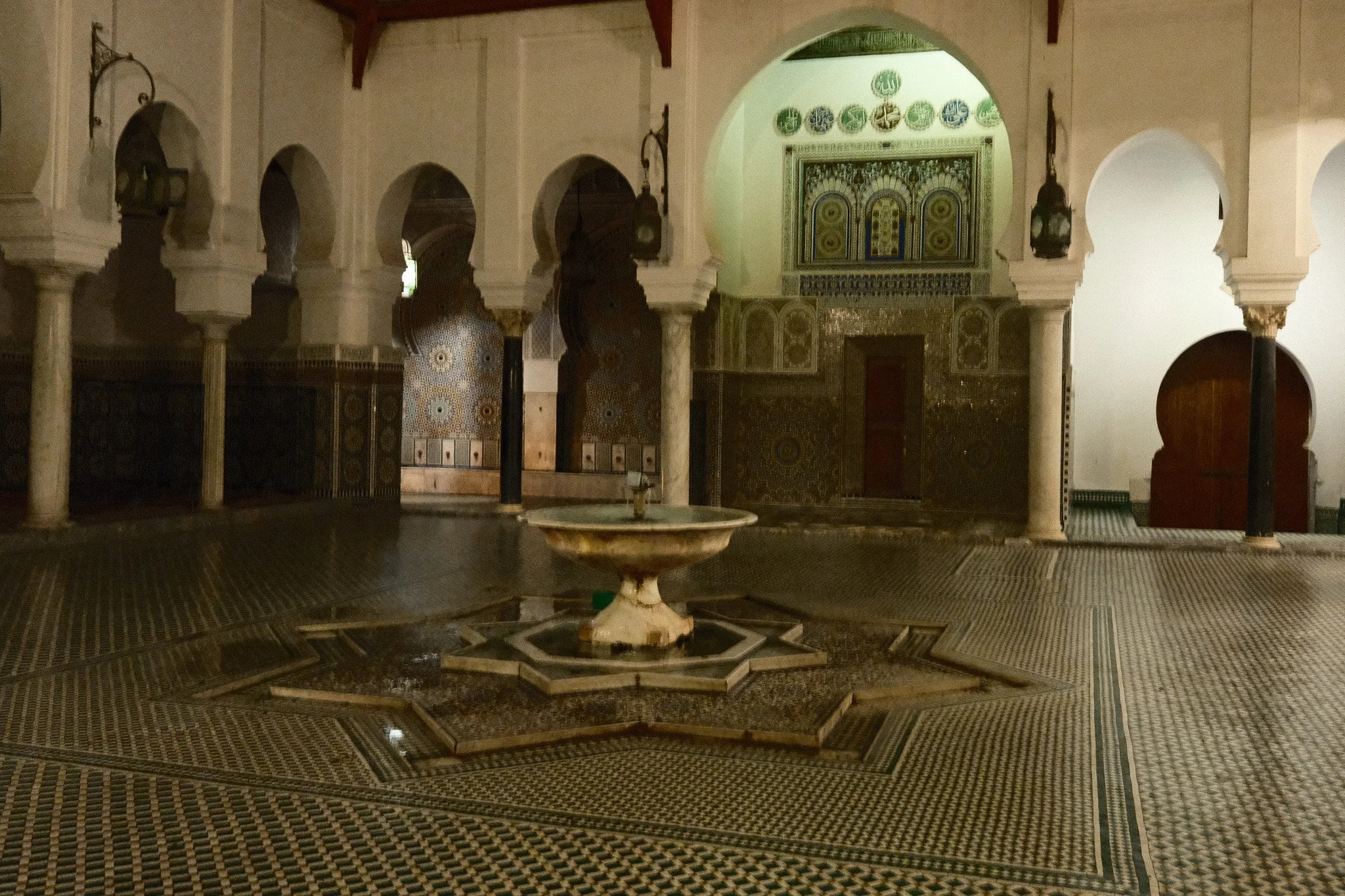
In Qarawayyin in Fez. The Oldest Institution in the World.
Some Muslims feel the need to “reform” or change Islam. When I was younger, I thought the same thing. I thought that as an American Muslim, there was something exceptional about me — that I could greatly benefit this ummah with my “unique” approach. I’ve found recently that nothing could be further from the truth. There are great systems in place that existed before me and will likely exist long after me. We are in need of Islam; Islam is not in need of us.
Before leaving for Umrah, a young man reached out to me and asked for dua.
“Samir, make dua that I can leave a legacy behind. That people remember me when I die and make dua for me.”
I felt this was a noble ambition, but I didn’t like the emphasis on people. If I have learned anything over the past decade, it’s that all the actions I took for the sake of people ended up backfiring completely, leaving me bitter and heartbroken. The actions I took for the sake of Allah (SWT) — I hold hope for the reward and blessings in them, without being consumed by the results. I thought about reprimanding him for his people-centric approach, but I was no different not long ago — so I simply told him to look forward and focus on building a relationship with Allah (SWT).
The question of leaving behind a legacy lingered with me throughout my Umrah.
The rains I had cherished in Medina had flooded Jeddah and Mecca, making travel by car and bus quite difficult. We decided to take the train instead, which took only two and a half hours to reach Mecca — almost too easy. On Hajj, I had been tested on the journey multiple times, so the ease made me uneasy. As we approached Jeddah and Mecca, I witnessed several flooded roadways and submerged cars. Alhamdulillah, that was not our situation.
We flagged down the first available person we saw at the train station in Mecca and got into a cab with him. The man spoke Arabic, but we didn’t understand most of what he was saying.
“Where are you from?”
I replied, “Pakistan.”
That wasn’t the answer he was looking for, and he pressed further.
“Where do you live?”
“America,” I replied.
He started cursing out America, then started tapping on my iPhone.
“How much did you spend on this?”
I didn’t know how to respond, and probably wouldn’t have even if I did.
There was some tension in the air. His phone wasn’t getting service, so he asked to use mine to navigate to the hotel. The tension broke momentarily when I mentioned “Saudi Arabia” and “Argentina” — the cab driver lit up briefly, realizing we were talking about the World Cup, but quickly fell back into frustration as flooded streets and police checkpoints blocked our way.
What should have been a fifteen-minute cab ride turned into an hour-long ordeal as we circled the area around the Haram. We were pulled over twice by Saudi police.
“Tell them I am taking you for Umrah.”
Strange, I thought. But I did as he asked. After our third loop around the area, several things dawned on me at once: this was not a real cab, the driver was not a real cab driver, he had no idea how to get to the hotel, and the checkpoints had been set up to prevent exactly the situation I had put my family in.
My fight-or-flight instinct started kicking in, but I was in a state of Ihram, so I had to stay calm.
It was the cab driver who lost patience first. He pulled over and waved over a desi man to translate.
“Where are you trying to go?” the desi man asked in Hindi.
“Hyatt Regency — Jabal Omar.”
The desi man relayed this to the cab driver, who became infuriated. “Hyatt Regency? HYATT REGENCY???!?!? JABAL OMAR?”
My blood pressure was rising. It felt like a hot iron was pressing on my head. Try not to lose your cool. You are in Ihram. The cab driver started smacking my phone.
The desi man said, “Listen, it’s better for you to walk to the hotel from here. There’s no way to get there by car right now. I can meet you there with your suitcases — if you like.” He then cracked a smile, and the paan he had been chewing dripped red juice from his teeth. I instantly lost whatever trust I had been building with that man.
Meet me there with my suitcases? Not a chance.
“Khalas. We are finished,” I told the cab driver. I got my family out of the car and we walked the rest of the way up the hill to the hotel. Umrah always has its tests. A train ride won’t change that.
Upon arriving at the Haram, memories of past Umrah trips came flooding back. I remembered the long, peaceful stretches of time I had spent here during my Hajj in 2017. I also remembered the stress of the year before that, when I was chaperoning students while working at Ghazaly High School.
“The Shaykh said it’s the same whether we pray in the hotel or in the Haram. It’s the same thing!”
“You came halfway across the world just to be lazy? We should get as close to the Haram as possible. I am not leaving a single person behind. We move as a group,” I responded firmly.
On that trip I was looking after my students; now I would be looking after my parents. It reminded me of the following hadith:
Abu Burdah reported: Ibn Umar, may Allah be pleased with him, watched a Yemeni man circling the House while carrying his mother on his back, saying, “I am her humble camel. If her mount is scared, I am not scared.” Then he said, “O Ibn Umar, do you think I have repaid her?” Ibn Umar said, “No, not even for a single pang of pregnancy.” (Source: al-Adab al-Mufrad 10)
The crowds were immense — nearly the same as what I had experienced during Hajj in 2017. It seems like it’s only during Umrah that the crowd melts into the background, and being jostled around doesn’t bother you nearly as much as it would anywhere else in the world. This time, there were several restrictions in place: all pilgrims in Ihram could only enter through Gate 79, and could only make tawaf on the first floor while wearing Ihram.
During my Hajj, I had barely shared any pictures or videos on social media — I didn’t want my actions to become insincere. This time, I came with a different intention. I shared many of my reflections and experiences live, so that my friends, family, and students back home could benefit. Though I recognize the irony, I was still uncomfortable seeing so many people taking selfies in front of the Kaabah. Who am I to appear anywhere in the frame when it comes to the first House of God built on Earth? Nevertheless, I did eventually slump against a pillar and take a picture.
Wearing the Ihram reminded me of death once again. Allah (SWT) will not look at our external appearance but at our hearts. The Ihram dissolves distinctions of class and race — everyone is equal in the eyes of Allah (SWT). Self-help gurus always talk about “time-boxing” your goals. There is no better time box than the remembrance of your own mortality.
The question of legacy returned to my mind. No one has a greater legacy than the Prophet Muhammad (S), Ibrahim (A), and Hajar (A) — billions of followers, without a single social media account. Theirs is a true legacy. Allah (SWT) teaches us that our guidance and path forward lies within our past. We are commanded to follow in the footsteps of these great men and women. They lived by Allah (SWT)’s commandments and worked tirelessly to please Him. When they served the creation, they did so to serve Allah (SWT). They expected nothing in return from people and sought no validation from them.
Walking between Safa and Marwa reveals different truths at different stages of one’s life. Allah (SWT) rewards those who seek Him, and He rewards their effort. Hajar (A) was searching for water when Allah (SWT) answered her dua — and He gave her the finest water, more than she had asked for. An entire community formed around her.
Those who have read the Seerah and know the Prophet’s life intimately taste a sweetness that others cannot reach. I thought of the Prophet (S)’s Umrah and his companions — why they uncovered their shoulders, why they jogged in certain places, the trials the Prophet (S) endured, and how he was initially denied Umrah despite the fact that the Quraysh had never previously denied any tribe from partaking in it.
Another blessing, as I mentioned in a previous post, was getting to meet with extended family. We hadn’t planned to meet in Mecca, but Allah (SWT) arranged it. I had dinner with my cousins, and I saw this reunion as a positive sign of Allah (SWT)’s acceptance and pleasure with us.
While making tawaf, I saw an elderly Indian woman decisively give up on life — she lay down on the floor, apparently willing to be trampled. I understood the sentiment. Who hasn’t felt beaten down by life at some point? But death by trampling? Another man saw her and blocked the tawaf circle from walking over her while I positioned myself in front. Should I help her up? Does she want to be helped? Yes — this is a matter of life or death. Get her up!
But before I could intervene, an Arab woman emerged from the crowd and knelt beside her. At first the Indian woman resisted, pressing herself to the floor — but the Arab woman locked eyes with her and, without saying a word, communicated love, compassion, empathy, and sorrow. The Indian woman received the message and slowly got up. She held onto the Arab woman, and together they made their way out of the circle to safety. I mention their backgrounds only to highlight the beauty of what I was witnessing: how people from different walks of life came together to save this woman’s life. Feeling somewhat useless, I gave her a bottle of Zamzam water I had been planning to carry out, and rejoined the tawaf.
Why Allah (SWT) chose me to witness that moment was a mystery at the time, but upon further reflection I can see multiple benefits. Through that scene, He showed me there is still good in this ummah — something I struggle to believe given my own past experiences with bitterness. Allah (SWT) sent multiple forms of help to that woman who had resigned herself to die. He sent someone to bear her pain, bring her to safety, and guide her back to the straight path. Whenever I begin to despair, I think of that elderly woman and remind myself that there is hope — and perhaps multiple forms of goodness already making their way to me. Allah (SWT) sent me a message that wasn’t immediately clear, but one I would surely need in the near future. How many signs does Allah (SWT) send us each day, while we remain heedless of them?
Legacy doesn’t have to be about grand gestures. It can be found in choosing patience over anger, caring for one’s parents, concealing one’s good deeds the way one conceals bad ones, reconnecting with family, or helping an elderly woman back to her feet in the middle of tawaf. Legacy is planting a seed in the hope that it benefits the creation — while knowing that what truly mattered was that you did it for Allah (SWT).
Anas ibn Malik reported: The Messenger of Allah, peace and blessings be upon him, said, “Even if the Resurrection were established upon one of you while he has a sapling in his hand, let him plant it.”
If this resonated with you, also read Omar Nofal and Only the Good Die Young.